
Introduction
Understanding the distinction between a temporary vs permanent visa is fundamental to making informed immigration decisions. Whether you’re planning to study abroad, work internationally, or settle permanently, knowing the differences between temporary and permanent visas determines your visa pathway, legal rights, work opportunities, and long-term residency prospects.
According to recent immigration data, approximately 67% of international migrants initially enter countries on temporary visas, with only a fraction successfully transitioning to permanent residency (Rebecca Black Law Visa Differences). This comprehensive guide explores the critical temporary vs permanent visa distinctions, explaining why each matters and how to strategically navigate your immigration journey.
Refined Focus Keyphrase Strategy:
Throughout this article, we consistently emphasize temporary vs permanent visa differences across duration, rights, pathways, and requirements—ensuring strong on-page SEO while maintaining readability.
What Is a Temporary Visa? Understanding Non-Immigrant Status
Definition and Purpose:
A temporary visa (also called non-immigrant visa) is government authorization for a foreign national to stay in a country for a limited, defined period for specific purposes. The fundamental characteristic of a temporary visa is its expiration date—when it expires, your legal right to remain ends unless extended or converted.
Key Characteristics of Temporary Visas:
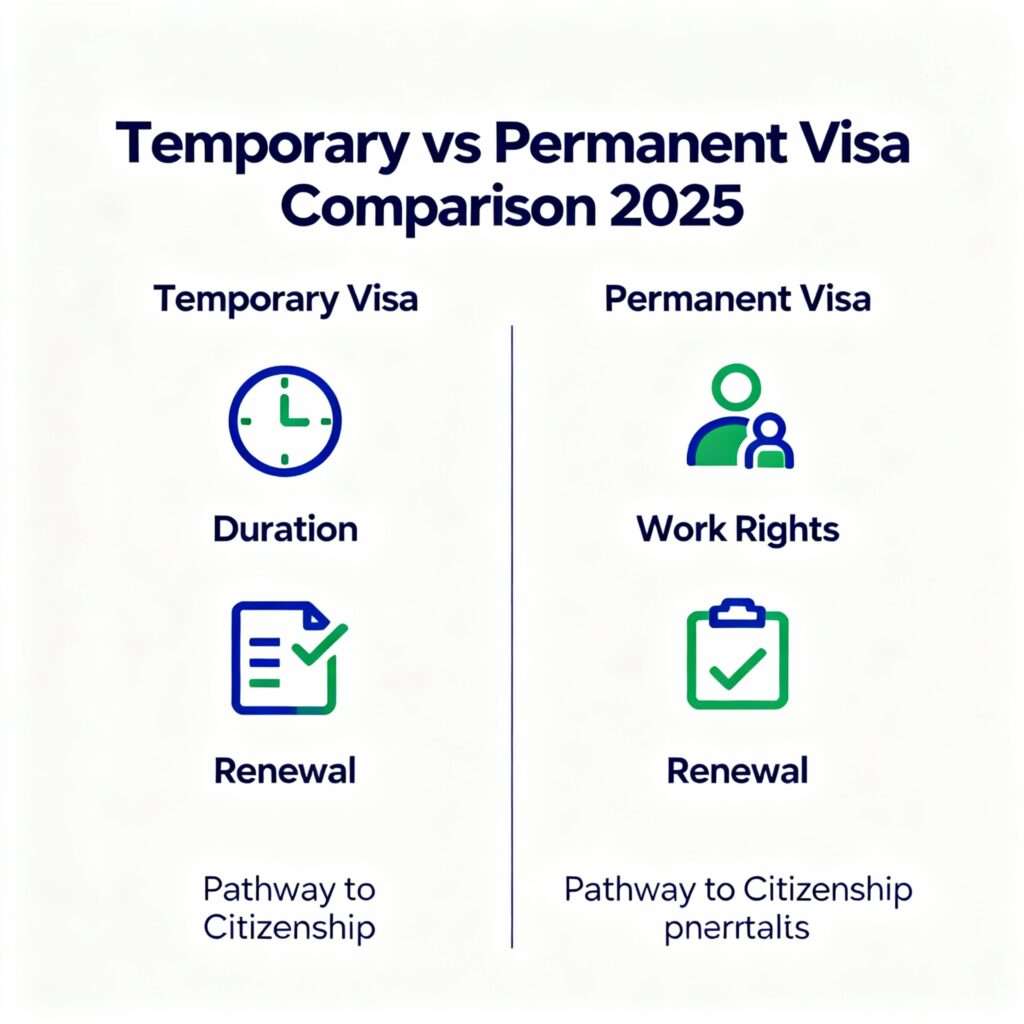
| Aspect | Details |
|---|---|
| Duration | Limited term (typically 6 months to 5 years) |
| Purpose | Specific purpose (work, study, tourism, investment) |
| Renewal | Requires periodic renewal applications |
| Pathway | May or may not lead to permanent residency |
| Rights | Restricted compared to permanent residents |
| Work Authorization | Conditional, often employer-specific |
Common Types of Temporary Visas:
- Student Visas (F-1, Subclass 500): For international students enrolled in educational institutions
- Work Visas (H-1B, Subclass 482 TSS): For skilled workers employed by sponsoring companies
- Tourist/Visitor Visas (B-1/B-2): For individuals visiting for leisure or business
- Investor Visas: For entrepreneurs investing capital in the country
- Exchange Visitor Visas (J-1): For participants in cultural and educational exchange programs
The critical distinction in a temporary vs permanent visa framework is that all temporary visas have defined endpoints.
What Is a Permanent Visa? Understanding Immigrant Status
Definition and Purpose:
A permanent visa (also called immigrant visa or permanent residency) grants foreign nationals the legal right to live, work, and reside indefinitely in a country. Unlike temporary visas, permanent visas have no expiration date (though documentation may require periodic renewal).
Key Characteristics of Permanent Visas:
| Aspect | Details |
|---|---|
| Duration | Indefinite (lifelong) |
| Purpose | Long-term settlement |
| Renewal | Document renewal, not status renewal (every 5-10 years) |
| Pathway | Direct path to citizenship (typically 3-7 years) |
| Rights | Broad rights equivalent to citizens (except voting) |
| Work Authorization | Unrestricted work anywhere in the country |
Common Types of Permanent Visas:
- Employment-Based Green Cards: For skilled workers and professionals
- Family-Sponsored Green Cards: For relatives of citizens or permanent residents
- Diversity Visas: Lottery-based immigration
- Investor/Entrepreneur Visas: For significant capital investment
- Refugee/Asylee Green Cards: For humanitarian protection seekers
The fundamental advantage in temporary vs permanent visa comparison is that permanent visas offer indefinite residence and work rights.
Difference #1: Duration and Validity Period
The Time Factor in Temporary vs Permanent Visa:
This is perhaps the most obvious temporary vs permanent visa distinction, yet its implications are profound.
Temporary Visa Duration:
- Typically 6 months to 5 years
- Specific end date clearly stated on visa documentation
- Overstaying results in penalties, deportation, and future visa denials
- Requires renewal applications well before expiration (6-12 weeks advance notice recommended)
- Each renewal resets the clock but doesn’t guarantee approval
Permanent Visa Duration:
- Indefinite validity (lifetime)
- No “expiration date” on residency status itself
- Documentation (Green Card, PR card) requires renewal every 5-10 years
- Renewal is administrative, not approval-based (status renewal ≠ documentation renewal)
- Allows lifelong residence without mandatory departure
Real-World Impact:
A temporary visa holder must plan their entire career around expiration dates. When their 3-year work visa expires, they must either:
- Return home
- Apply for visa extension (uncertain outcome)
- Transition to permanent residency (lengthy process)
- Switch to different temporary visa category
A permanent visa holder works freely, changes employers without restriction, and builds long-term career plans.
This temporary vs permanent visa difference fundamentally affects life planning and career trajectory.
Difference #2: Rights, Restrictions, and Access to Benefits
The Rights Disparity in Temporary vs Permanent Visa:
Perhaps the most consequential temporary vs permanent visa difference involves legal rights and access to social benefits.
Temporary Visa Restrictions:
| Right/Benefit | Typical Access |
|---|---|
| Work Authorization | Conditional (employer-specific, occupation-specific) |
| Travel Freedom | Limited (may require new visa to re-enter) |
| Social Benefits | Restricted (no unemployment, limited healthcare) |
| Education | Limited (no access to in-state tuition, some restrictions) |
| Driving/ID | Limited (may not qualify for state ID in some jurisdictions) |
| Banking | More difficult (additional documentation required) |
| Leasing/Housing | Challenging (landlords hesitant about temporary status) |
Permanent Visa Benefits:
| Right/Benefit | Full Access |
|---|---|
| Work Authorization | Unrestricted (any employer, any occupation) |
| Travel Freedom | Broad (re-entry guaranteed with valid documentation) |
| Social Benefits | Full access (unemployment, healthcare, education subsidies) |
| Education | In-state tuition, professional licensing opportunities |
| Driving/ID | State ID, driver’s license issued |
| Banking | Standard access like citizens |
| Leasing/Housing | Equal treatment to citizens |
Concrete Example of Temporary vs Permanent Visa Restrictions:
A temporary visa holder wants to change jobs. Often, they must:
- Seek employer sponsorship for new position
- Apply for visa amendment
- Face potential gaps in authorization
- Risk falling out of status
A permanent visa holder simply resigns and starts new employment immediately. This temporary vs permanent visa difference profoundly affects career mobility and financial stability.
(Morgan Clifford Australia Comparison)
Difference #3: Application Process and Eligibility Requirements
The Pathway Complexity in Temporary vs Permanent Visa:
The temporary vs permanent visa application processes differ significantly in complexity, timeline, and eligibility criteria.
Temporary Visa Application Process (typically 2-12 weeks):
- Initial Assessment: Determine visa category eligibility
- Documentation Preparation: Gather required documents (passport, supporting letters, financial proof)
- Application Submission: Online or at embassy/consulate
- Biometric Appointment: Fingerprints and photographs (if required)
- Interview (sometimes): Answer officer questions about purpose and ties to home country
- Processing: Government review and assessment
- Decision: Approval, conditional approval, or rejection
- Visa Issuance: Stamp in passport or e-visa
Typical Temporary Visa Eligibility:
- Proof of ties to home country
- Demonstration of purpose (school enrollment, job offer, hotel reservation)
- Sufficient financial resources for stay duration
- Clean criminal background
- Health requirements (if applicable)
- Intent to return home after authorized period
Permanent Visa Application Process (typically 6-24 months):
- Preliminary Qualification: Meet points test, family relationship, or employment criteria
- Expression of Interest (EOI): Preliminary application in many countries
- Comprehensive Application: Detailed biographical, employment, and family information
- Document Verification: Notarization, police clearances, medical examination
- Background Checks: Criminal history, security screening
- Employment Verification: Contact previous employers
- Interview (often required): Detailed discussion of intentions
- Extended Processing: Longer government assessment
- Final Decision: Approval or conditional approval
- Permanent Visa Grant: Formal residency status granted
Typical Permanent Visa Eligibility:
For temporary vs permanent visa comparison, permanent visas typically require:
- Higher qualification levels (education, experience, or investment)
- Proof of long-term employment or family connections
- Demonstration of adaptation ability
- Often points-based scoring
- Long-term commitment to country
Key Difference: Temporary visas assess short-term purpose fulfillment. Permanent visas assess long-term integration viability and contribution.
Difference #4: Pathway to Citizenship and Legal Status Progression
The Citizenship Route in Temporary vs Permanent Visa:
The temporary vs permanent visa distinction creates fundamentally different citizenship pathways.
From Temporary Visa:
- Generally NO direct path to citizenship
- Temporary visa ≠ pathway to permanent residency
- Must independently qualify for permanent residency
- Timeline: 4-8 years minimum (temporary visa → PR application → PR approval → citizenship eligibility)
- Requires multiple applications and status changes
From Permanent Visa:
- Clear, established pathway to citizenship
- After 3-7 years of permanent residency (varies by country), eligible for citizenship application
- Significantly higher approval probability
- Citizenship requirements: residency period, language proficiency, civics test (often)
- Timeline: 6-10 years total (permanent visa approval → citizenship eligibility → citizenship approval)
Comparison Table:
| Path | Duration | Approval Rate | Complexity |
|---|---|---|---|
| Temporary → Permanent → Citizenship | 8-15 years | 40-60% | Very High |
| Permanent → Citizenship | 6-10 years | 85-95% | Moderate |
For applicants seeking citizenship, a temporary vs permanent visa starting point dramatically affects timeline and success probability.
Difference #5: Renewals, Maintenance, and Compliance Requirements
The Ongoing Obligations in Temporary vs Permanent Visa:
Once obtained, temporary vs permanent visa maintenance requirements differ substantially.
Temporary Visa Maintenance:
| Requirement | Details |
|---|---|
| Expiration Monitoring | Strict deadline tracking; overstay has severe consequences |
| Renewal Applications | Submit 6-12 weeks before expiration with updated documentation |
| Compliance Conditions | Must remain in compliance with visa conditions (work only for sponsor, study full-time, etc.) |
| Change of Status | If circumstances change, must apply for amendment or new visa |
| Reporting | Regular check-ins, address updates, employment reporting (some countries) |
| Employment Changes | Often requires new visa application or amendment |
| Address Changes | Frequent requirement to notify immigration |
Permanent Visa Maintenance:
| Requirement | Details |
|---|---|
| Status Indefinite | No expiration of residency status itself |
| Document Renewal | Physical documentation (Green Card, PR card) renewed every 5-10 years |
| Minimal Reporting | Usually only address updates required |
| Work Freedom | No employment-related requirements |
| Travel Flexibility | Can travel freely with only documentation renewal concerns |
| Residency Maintenance | May require demonstrating connection (typically 183 days/year) |
| No Condition Compliance | After approval, few conditions to maintain |
Critical Differences:
In the temporary vs permanent visa framework, temporary visa holders live under constant compliance pressure. Breaking conditions means status loss and deportation.
Permanent visa holders enjoy stability with minimal administrative burden. Status maintenance is largely automatic.
(Savory and Partners Maintenance)
Transitioning from Temporary to Permanent Visa
Can You Convert Temporary to Permanent?
In the temporary vs permanent visa journey, many applicants eventually transition. However, it’s not automatic.
Requirements to Convert Temporary to Permanent:
- Meet Permanent Residency Criteria:
- Employment-based: Often requires employer sponsorship and job offer
- Family-based: Usually requires family member who is citizen/permanent resident
- Points-based: Must accumulate sufficient points through experience, education, language skills
- Investment: May require substantial capital investment
- Maintain Legal Status:
- Never let temporary visa expire
- Comply with all conditions during temporary period
- Gain Relevant Experience:
- Work experience in nominated occupation
- Professional qualifications and credentials
- Language proficiency improvements
- Employer Sponsorship (if applicable):
- Employer nominates you for permanent residency pathway
- Sponsorship letter and employment documentation required
Timeline for Conversion:
- Average: 2-5 years on temporary visa before permanent residency eligibility
- Processing: 1-2 years for permanent visa application
- Total typical duration: 3-7 years
The temporary vs permanent visa transition pathway varies significantly by country, occupation, and individual circumstances.
Conclusion: Choosing Between Temporary and Permanent Visa
The temporary vs permanent visa decision isn’t always yours to make initially, but understanding the differences helps you plan strategically.
Choose Temporary Visa If:
- Short-term goals (study one program, work contract, testing relocation)
- Unsure about permanent commitment
- Want to maintain home country base
- Need quick visa processing
Pursue Permanent Visa If:
- Long-term settlement planned
- Career building abroad intended
- Family relocation involved
- Citizenship pathway desired
- Ready to commit 3-7+ years to residency
The temporary vs permanent visa distinction fundamentally shapes your immigration experience, rights, opportunities, and long-term success.
Ready to strategically navigate your immigration path? Ausizz Migration Consultants specializes in helping applicants understand temporary vs permanent visa options, creating strategic pathways from temporary status toward permanent residency. Our consultants assess your unique circumstances and recommend the optimal visa strategy aligned with your long-term goals.
Book your immigration strategy consultation: Ausizz Migration Consultants
Frequently Asked Questions (FAQs)
Q1: Can I stay on a temporary visa indefinitely by renewing?
A1: No. Temporary visa renewals reset your authorized period but don’t change your temporary status. Most countries limit total renewal periods (often 5-10 years maximum). To stay indefinitely, you must eventually transition to permanent residency.
Q2: Do temporary visas count toward permanent residency requirements?
A2: Sometimes. Some countries recognize temporary residency periods toward permanent residency eligibility. However, this isn’t universal—check your country’s specific rules.
Q3: If my temporary visa expires, can I stay while awaiting permanent visa decision?
A3: Not automatically. However, some applications allow “bridging visas” that permit legal residence while your permanent visa application processes. Always consult immigration officials before temporary visa expiration.
Q4: What happens if I overstay a temporary visa?
A4: Serious consequences including deportation, permanent visa bans (often 5-10 years), fines, criminal record, and difficulty re-entering the country. Never overstay intentionally.
Q5: Is permanent residency the same as citizenship?
A5: No. Permanent residency grants indefinite residence but not citizenship. Citizenship (naturalization) requires completing additional requirements typically 3-7 years after permanent residency approval.
