
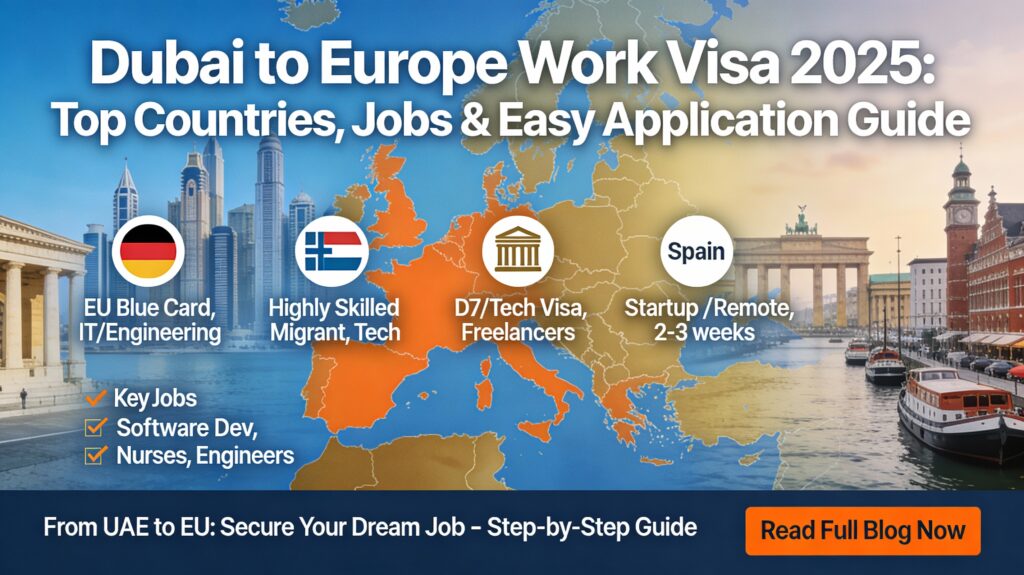
Living in Dubai offers a dynamic lifestyle, but for many residents, the ultimate career goal lies across the Mediterranean. In 2025, Europe faces a massive labor shortage, opening its doors wider than ever to skilled professionals from the UAE.
From the Germany Opportunity Card to Portugal’s Job Seeker Visa, there are now direct pathways that do not require you to have a job offer before you land. If you are a Dubai resident looking to move from Dubai to Europe Work Visa, this guide breaks down the easiest countries to target, high-demand jobs, and the step-by-step Europe work permit application process.
Top 3 Easiest European Countries for Work Visas (2025)
Based on approval rates and streamlined policies for UAE residents, these three countries are your best bets.
1. Germany: The “Opportunity Card” (Chancenkarte)
Germany has revolutionized its immigration with a points-based system similar to Canada.
- Why it’s #1: You do not need a job offer to enter. You can move to Germany and look for work for up to one year.
- Eligibility: You need 6 points based on age, qualifications, language skills (English or German), and experience.
- Work Rights: You can work part-time (20 hours/week) while searching for a full-time role.
2. Portugal: The Job Seeker Visa
Perfect for freelancers and digital nomads, this visa allows you to enter Portugal specifically to find employment.
- Validity: 120 days (extendable by 60 days).
- Perk: Once you find a job, you can apply for a residence permit directly. After 5 years, you can apply for citizenship (and an EU passport!).
- Cost: Low proof of funds required (approx. 3 months of minimum wage).
3. Poland: The Outsourcing Hub
Poland issues thousands of work permits to non-EU citizens annually to fill gaps in logistics, IT, and construction.
- Process: Your Polish employer applies for a “Type A” work permit on your behalf.
- Success Rate: Very high for blue-collar and mid-level technical roles.
High-Demand Jobs in Europe for Dubai Residents
Europe is desperate for talent in these sectors. If you have experience in Dubai in these fields, your chances of approval skyrocket.
| Sector | Roles in Demand | Best Countries |
|---|---|---|
| Healthcare | Nurses, Doctors, Elderly Care | Germany, UK, Ireland |
| Technology | Developers, Data Scientists, Cybersecurity | Netherlands, Estonia, Germany |
| Construction | Electricians, Welders, Civil Engineers | Poland, Croatia, France |
| Hospitality | Chefs, Hotel Managers | Malta, Italy, Spain |
| Transport | Truck Drivers, Logistics Coordinators | Poland, Lithuania, Romania |
Step-by-Step: Europe Work Permit Application from Dubai
The process varies by country, but the core steps for a Dubai to Europe move remain similar.
Step 1: Secure a Job Offer (Or Apply for Job Seeker Visa)
- For most countries (like Poland or Malta), you need a confirmed employment contract first.
- For Germany/Portugal, you can apply for a Job Seeker visa without an offer.
Step 2: Gather Documents
- Valid Passport: Must be valid for at least 3-6 months beyond your intended stay.
- UAE Residence Visa: Must be valid for at least 3 months from the date of application.
- Police Clearance Certificate (PCC): From Dubai Police (available online via the Dubai Police app).
- Proof of Funds: Bank statements (last 3-6 months) showing you can support yourself.
- Travel Insurance: Coverage of €30,000 min.
Step 3: Online Application & Appointment
- Fill out the National Visa (Type D) form for the specific country.
- Book an appointment at VFS Global or the respective embassy in Dubai/Abu Dhabi.
Step 4: Biometrics & Interview
- Attend the interview. Be honest about your intent. If you are on a Job Seeker visa, have a clear plan on how you will find a job (list of companies, interviews lined up).
Step 5: Visa Approval & Travel
- Processing time: 4 to 12 weeks on average.
- Once approved, you get a visa stamped in your passport. Fly to Europe and apply for your Residence Permit upon arrival.
Frequently Asked Questions (FAQ)
Q1: Do I need a job offer to apply for a Europe work visa?
For most work visas (like the EU Blue Card or Poland Type A), yes. However, countries like Germany (Opportunity Card) and Portugal (Job Seeker Visa) allow you to enter without a job offer to look for employment.
Q2: Can I apply for a Europe work visa with a tourist (Schengen) visa?
Generally, no. You cannot switch from a tourist visa (Type C) to a work permit while inside most European countries. You must return to Dubai and apply for a National Visa (Type D) from the embassy there.
Q3: Can I bring my family with me?
Yes, but usually after you have settled. Once you have a valid residence permit and a stable income, you can apply for family reunification for your spouse and children. Some high-skilled visas (like the EU Blue Card) allow family to join immediately.
Q4: How much does the Europe work visa cost?
The visa application fee is typically €75 – €150 (approx. AED 300 – 600). However, total costs (including insurance, translations, and VFS fees) can range from AED 1,500 to AED 3,000.
Q5: My UAE visa is expiring soon. Can I still apply?
Most embassies require your UAE residence visa to be valid for at least 3 months after you return from Europe. If it’s expiring soon, renew your UAE visa first before applying for the European one.
Start Your European Career
Moving from Dubai to Europe is a life-changing decision. Whether you choose the stability of Germany or the sunny coast of Portugal, the 2025 policies are in your favor.
Need Help with Your Application?
Don’t risk a refusal due to paperwork errors. At Ausizz Migration Consultants, we specialize in European work permits for UAE residents.
Get a Free Profile Assessment Today!
Contact Ausizz Migration Consultants:
- Website: www.ausizzmigrationconsultants.com