
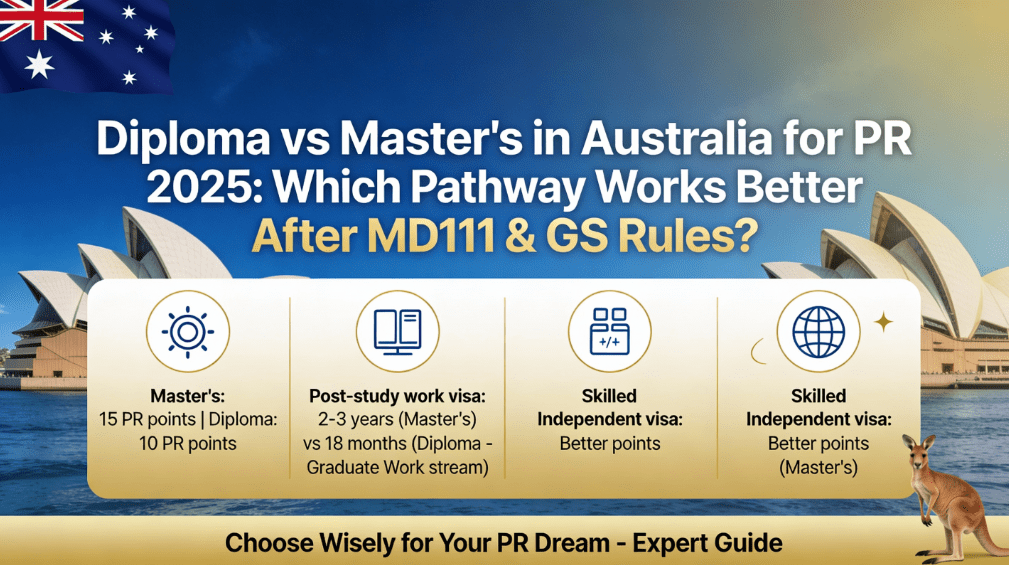
For Indian students considering studying abroad, Australia represents one of the most attractive destinations for combining world-class education with a clear pathway to permanent residency. However, the choice between pursuing a postgraduate diploma vs masters can significantly impact your future career and migration prospects. With the introduction of Ministerial Direction 111 (MD111) and the new Genuine Student (GS) requirement in 2025, understanding which pathway offers better job opportunities has become more critical than ever.
This comprehensive guide explores both pathways in detail, analyzing how each qualification impacts your job opportunity prospects, permanent residency eligibility, and long-term career success in Australia.
Critical Changes in Australia’s Education and Immigration System (2025)
Ministerial Direction 111 (MD111)
Effective December 19, 2024, MD111 replaced MD107 and introduced a two-tier priority processing system for student visas(see the generated image above). This new framework prioritizes applications from:
- Higher degree by research (HDR) students
- Scholarship recipients
- TAFE institution students
- Students from Pacific regions and Timor-Leste
The system aims to create equity among education providers by distributing student visa places based on institutional allocation thresholds. Approximately 80% of applications receive Priority 1 (faster) processing, while the remaining 20% face standard processing.
Genuine Student (GS) Requirement
The old Genuine Temporary Entrant (GTE) requirement has been replaced by the GS (Genuine Student) requirement. Unlike its predecessor, the GS requirement demands that students clearly demonstrate their primary intent is to study and gain academic benefits—not to use education as a backdoor to migration. This means:
- Well-prepared, comprehensive documentation is essential
- Character and financial capacity assessments are more rigorous
- Application rejections are more likely for those who cannot convincingly prove genuine educational intent
International Student Cap
Australia has implemented a 270,000-student cap for 2025, down from previous years, with higher education (master’s and doctoral programs) receiving more favorable weighting than vocational training. This prioritization of higher education directly benefits master’s degree applicants.
Postgraduate Diploma: PR Pathway Analysis
Eligibility for Post-Study Work Rights
This is the critical distinction. In 2025, postgraduate diplomas are no longer eligible for the Temporary Graduate Visa (Subclass 485) under the Post-Study Work Stream. While some sources reference the Graduate Work Stream accepting diplomas for 18 months, this stream requires:
- The diploma holder’s occupation to be on the Medium and Long-Term Strategic Skills List (MLTSSL)
- Skills assessment by the relevant authority
- Only 18 months of work rights, compared to 2-3 years for master’s graduates
The critical issue: without access to the Post-Study Work Stream (typically 2-3 years), diploma holders cannot effectively gain the Australian work experience needed to accumulate PR points.
PR Points Breakdown for Diploma Holders
| Category | Points |
|---|---|
| Diploma Qualification | 10 |
| Competent English (IELTS 6.0 each) | 0 |
| Proficient English (IELTS 7.0) | 10 |
| Australian Work Experience (1-3 years) | 5-10 |
| Overseas Work Experience (3+ years) | 5-10 |
| State Sponsorship | 5-15 |
| Minimum to reach 65 points | Must accumulate from multiple categories |
Key limitation: Diploma holders cannot claim points for the Australian Study Requirement (5 points), which requires a minimum 2-year full-time course. Graduate diplomas typically range from 9 months to 1.7 years, falling short of this threshold.
Job Opportunities for Diploma Graduates
Career prospects after a postgraduate diploma are limited compared to master’s degrees:
- Limited to specific occupations on skilled occupation lists
- Lower average salaries than master’s degree holders
- Difficulty competing for professional roles requiring degrees
- Restricted career progression in most industries
Master’s Degree: Superior PR Pathway
Eligibility for Post-Study Work Rights
Master’s degree holders have clear, direct access to the Temporary Graduate Visa (485) – Post-Study Work Stream. Duration depends on qualification level and region:
| Qualification | Standard Duration | Regional Bonus |
|---|---|---|
| Master’s (Coursework) | 2-3 years | +1-2 years possible |
| Master’s (Research) | 3-4 years | +1-2 years possible |
| PhD | 4 years | +1-2 years possible |
This extended work period is essential for building Australian work experience and PR points.
PR Points Breakdown for Master’s Graduates
| Category | Points |
|---|---|
| Master’s Degree (Education) | 15 |
| Australian Study Requirement (2+ years) | 5 |
| Australian Work Experience (1 year) | 5 |
| Australian Work Experience (3-5 years) | 10 |
| Australian Work Experience (5+ years) | 15 |
| Proficient English (IELTS 7.0) | 10 |
| Superior English (IELTS 8.0) | 20 |
| Regional Study/Work | 5-15 |
| State Sponsorship | 5-15 |
| Professional Year | 5 |
| Total Potential | 60-90+ points |
Master’s graduates can comfortably reach the minimum 65 points required for Subclass 189 (Skilled Independent Visa) invitations.
Job Opportunities for Master’s Graduates
The employment landscape is dramatically different for master’s degree holders in Australia:
- 71% employment rate within 6 months of graduation
- High-demand fields: Information Technology, Engineering, Healthcare, Nursing, Accounting, Data Science, Teaching
- Average salaries:
- Master’s graduates earn approximately AUD 40-50 lakhs per annum in PR-eligible fields
- Clear pathways to leadership and senior roles
- Access to employer sponsorship for regional shortage occupations
English Language Requirements (Updated August 2025)
Both diploma and master’s applicants must meet the new English proficiency standards effective August 7, 2025:
- Minimum IELTS: 6.5 overall with 5.5 minimum in each band (Listening, Reading, Writing, Speaking)
- Equivalent PTE: 55 overall with 42 minimum in each band
- Validity: Test results must be recent (within 12 months of application)
These higher requirements are designed to ensure students can perform effectively in Australian workplaces and society.
PR Application Process: Master’s vs Diploma
Master’s Pathway (Recommended)
- Complete 2-year master’s degree from a CRICOS-registered institution
- Apply for Temporary Graduate Visa (485) within 6 months of degree completion (2-4 years work rights)
- Gain Australian work experience in nominated occupation (minimum 1 year)
- Obtain skills assessment from relevant professional body (ACS for IT, Engineers Australia, etc.)
- Achieve 65+ points on points-based system
- Submit Expression of Interest (EOI) to SkillSelect
- Receive invitation from Department of Home Affairs
- Apply for PR visa (Subclass 189, 190, or 491)
- Obtain PR status
Timeline: Typically 3-5 years from degree completion to PR
Diploma Pathway (Limited)
- Complete postgraduate diploma (typically 12-18 months)
- Apply for Temporary Graduate Visa (485) – only 18 months under Graduate Work Stream if occupation is on MLTSSL
- Gain limited Australian work experience (barely 1.5 years)
- Obtain skills assessment (may not be applicable for all diploma occupations)
- Struggle to reach 65 points due to:
- Only 10 points for diploma (vs. 15 for master’s)
- No Australian Study Requirement points
- Limited work experience accumulation
- Alternative: Seek employer sponsorship or state sponsorship (significantly more difficult)
Timeline: Uncertain; many diploma holders find PR pathways blocked
Cost-Benefit Analysis: Investment vs. Returns
Master’s Degree Investment
- Duration: 1-2 years of study
- Tuition Cost: AUD 40,000-60,000+ per year
- Total Cost: AUD 80,000-120,000
- Post-Study Work Rights: 2-4 years
- Earning Potential (Post-Study): AUD 90,000-150,000+ annually
- PR Probability: 75-85% (with proper planning)
- Return on Investment (ROI): High—salary earnings during work visa period typically exceed education costs
Diploma Investment
- Duration: 9 months – 1.7 years
- Tuition Cost: AUD 20,000-40,000
- Total Cost: Lower upfront
- Post-Study Work Rights: 18 months ONLY
- Earning Potential: AUD 60,000-90,000 annually
- PR Probability: Less than 30% without employer support
- Return on Investment: Low—reduced earning period and limited PR prospects make this a poor investment if permanent residency is the goal
Top PR-Eligible Master’s Fields for Indian Students in 2025
Given Australia’s labor market priorities and the 2025 skilled occupation list, these master’s programs offer strong PR prospects:
| Field | Average Salary | Demand Level | PR Accessibility |
|---|---|---|---|
| Information Technology | AUD 90,000-110,000 | Very High | Excellent |
| Data Science/Analytics | AUD 100,000-130,000 | High | Excellent |
| Software Engineering | AUD 95,000-115,000 | Very High | Excellent |
| Nursing (Master’s) | AUD 85,000-130,000 | Very High | Excellent |
| Mechanical Engineering | AUD 85,000-110,000 | High | Excellent |
| Civil Engineering | AUD 80,000-105,000 | High | Excellent |
| Accounting (Masters) | AUD 80,000-100,000 | Very High | Good (competitive) |
| Business Administration (MBA) | AUD 100,000+ | High | Good |
| Project Management | AUD 95,000-120,000 | High | Good |
| Cybersecurity | AUD 105,000-140,000 | Very High | Excellent |
Regional Study Advantages (2025)
Both master’s and diploma holders benefit from regional study, but master’s graduates see greater returns:
| Benefit | Master’s | Diploma |
|---|---|---|
| Additional PR Points | 5 points | 5 points |
| Extended 485 Work Rights | 1-2 additional years | Limited benefit |
| State Sponsorship Access | Easier (Subclass 190/491) | More difficult |
| Second 485 Visa Eligibility | Yes (1-2 years additional) | No |
| Career Prospects | Enhanced by region-specific employers | Limited growth |
Top regional locations for Indian students: South Australia, Tasmania, regional New South Wales, regional Victoria
State Sponsorship Opportunities (2025)
State nomination under Subclass 190 or Subclass 491 (regional) adds 5-15 points depending on the visa type. Master’s degree holders have significantly better state sponsorship prospects:
- States actively seeking master’s graduates: South Australia, Tasmania, Western Australia
- In-demand occupations: Healthcare professionals, IT specialists, engineers, educators
- Processing advantage: Faster visa processing and clearer pathways
Diploma holders rarely qualify for state sponsorship unless they have specific occupation matches or employer support.
Critical Takeaways for Indian Students in 2025
Why Master’s Wins
- Post-Study Work Visa Access: 2-4 years vs. 18 months for diplomas
- Points Accumulation: Can reach 65+ points; diplomas struggle
- Job Market Competitiveness: Master’s graduates earn 25-40% more on average
- Career Progression: Clear pathways to leadership roles
- PR Certainty: 75-85% success rate with proper planning
- Employment Rate: 71% placement within 6 months
- Flexibility: Can pivot to multiple visa pathways (189, 190, 491, employer sponsorship)
Why Diploma Falls Short
- No Post-Study Work Stream Access: Severely limits work experience building
- Insufficient Points: Cannot easily accumulate 65 points
- Limited Occupations: Restricted to specific skilled occupations
- Career Ceiling: Lower salary potential and advancement
- PR Uncertainty: 30% or lower success probability without employer support
- Time Wasted: 18 months work visa may not be enough to achieve PR-eligible experience
Recommendations for Indian Students
If Your Goal is Permanent Residency:
- Choose a master’s degree in a high-demand field (IT, Engineering, Healthcare, Data Science)
- Prioritize CRICOS-registered 2-year programs to qualify for Australian Study Requirement points
- Consider studying in regional areas for additional work visa and PR points
- Select occupations on the MLTSSL to ensure skills assessment eligibility
- Plan for 2-4 years post-study work to accumulate experience and points
- Engage a registered migration agent to optimize your points and visa pathway
If Budget is a Constraint:
- Diploma + Employer Sponsorship: Complete a diploma and secure employer support for visa sponsorship (most feasible alternative)
- Scholarship Programs: Seek scholarships for master’s programs to reduce costs
- Graduate Diploma + University Transition: Some universities allow graduate diploma credits toward master’s degrees, reducing total cost
If You’re Flexible on Timeline:
- Master’s degree provides certainty over longer timelines
- Diploma works only if immediate employer sponsorship is arranged
- Master’s pathway takes 4-5 years but offers security; diploma pathway is unpredictable
Conclusion
In 2025, under the new MD111 and GS requirements, the choice between a postgraduate diploma and a master’s degree for Australian PR is clear: a master’s degree is overwhelmingly superior. While diplomas cost less upfront, they offer minimal PR prospects, limited work rights, and insufficient points accumulation. Master’s graduates, by contrast, enjoy extended post-study work periods, strong employment outcomes, and a clear pathway to permanent residency through the points-based system.