
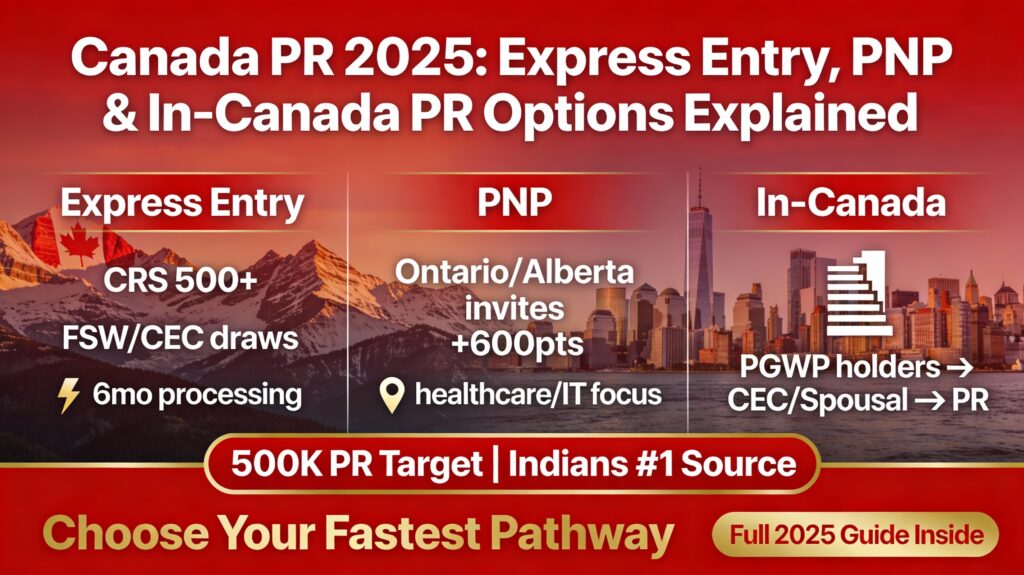
Securing Canada Permanent Resident (PR) status in 2025 has become a game of strategy, not just points. The days of generic, all-program draws clearing the backlog are over. Immigration, Refugees and Citizenship Canada (IRCC) has pivoted to a highly targeted, category-based approach to fill specific economic needs.
If you are waiting for a generic invitation with a moderate Comprehensive Ranking System (CRS) score (e.g., 480-490), you might be waiting indefinitely. However, if you possess skills in Healthcare, Trades, or French proficiency, or if you are already working in Canada, 2025 offers unprecedented opportunities.
This comprehensive guide decodes the Canada immigration landscape for 2025, explaining the new Express Entry categories, the rise of specialized PNP streams, and the critical “In-Canada” pathways for work permit holders.
1. Express Entry 2025: The “Category-Based” Shift
The most significant change in Canada’s federal selection system is the shift away from raw CRS scores toward Category-Based Selection. While CRS scores still matter, IRCC now holds specific draws for candidates with work experience in priority sectors.
The 2025 Priority Categories
If you have at least 6 months of continuous work experience (in the last 3 years) in one of these fields, you can receive an Invitation to Apply (ITA) with a CRS score significantly lower than the general cutoff.
- French-Language Proficiency: This is the absolute #1 priority for 2025.
- Advantage: If you score NCLC 7 in French (roughly intermediate level), you can get invited with scores as low as 350-400.
- Points Boost: You also get 50 bonus CRS points for strong French skills (even if English is your first language), making this the single most effective way to boost your profile.
- Healthcare: Doctors, Nurses, Dentists, Pharmacists, and Psychologists remain in critical demand.
- STEM: Software Developers, Data Scientists, Civil Engineers, and Cybersecurity Specialists.
- Trades: Carpenters, Plumbers, Electricians, Welders, and Industrial Mechanics.
- Education: New for 2025! Teachers (elementary and secondary) and Early Childhood Educators are now a standalone priority category to address shortages in schools.
- Agriculture & Agri-Food: Butchers, farm supervisors, and food processing workers.
Strategy: If your CRS is stuck in the high 400s, learning French is your best investment. Alternatively, if you work in a generic corporate role (e.g., Marketing Manager), consider pivoting your application to a PNP stream, as federal general draws will remain extremely competitive (CRS 520+).
2. Provincial Nominee Programs (PNP): The “Backdoor” to PR
With federal draws becoming tougher, provinces have become the primary pathway for many applicants. In 2025, a provincial nomination adds 600 points to your CRS score, effectively guaranteeing an ITA in the next draw.
Key PNP Trends for 2025:
- British Columbia (BC PNP):
- New Graduate Streams: Starting January 2025, BC has overhauled its international graduate streams.
- Bachelor’s Stream: Requires a full-time, indeterminate job offer in a skilled occupation.
- Master’s Stream: Requires a full-time job offer (min. 1 year) in any skilled field.
- Doctorate Stream: For PhD graduates/students.
- Critical Requirement: All these streams now require a minimum language score of CLB 8, raising the bar for graduates.
- Ontario (OINP):
- Tech Draws: Ontario continues to hold targeted draws for tech workers under the Human Capital Priorities stream.
- Trades & Health: Heavy focus on candidates with job offers in construction and healthcare outside the Greater Toronto Area (GTA).
- Alberta (AAIP):
- Tourism and Hospitality Stream: A dedicated pathway for workers in this sector who have a valid job offer and work permit.
- Dedicated Healthcare Pathway: Fast-tracked processing for healthcare professionals with Alberta job offers.
Strategy: Do not just create an Express Entry profile and wait. actively check PNP websites. Applying directly to a province (like Saskatchewan or Manitoba) often has lower point thresholds than the federal system.
3. In-Canada PR Options (For Work Permit Holders)
Already in Canada on a work permit or Post-Graduation Work Permit (PGWP)? You have a massive home-ground advantage. IRCC has explicitly stated its goal to “transition more temporary residents to permanent residence.”
Canadian Experience Class (CEC)
- Requirement: 1 year of skilled work experience in Canada (TEER 0, 1, 2, or 3) within the last 3 years.
- 2025 Outlook: Expect more “CEC-Only” draws. Recent draws have seen CRS cutoffs drop to 515, significantly lower than general draws. This trend is expected to continue as IRCC tries to retain workers already integrated into the economy.
The “One-Time” Pathway (2026-27 Preview)
In a major announcement, Ottawa revealed plans to create a special one-time pathway to convert 33,000 work-permit holders to permanent residents starting late 2025 or early 2026.
- Target Audience: Essential workers (Healthcare, Construction, Food Supply) and those with Canadian work experience who may not qualify for Express Entry.
- Likely Criteria: Minimum language score of CLB 4 or 5 and current employment in Canada.
- Action: If you are a semi-skilled worker (TEER 4/5) in Canada, keep your language test results valid and stay employed. This could be your version of the famous “TR to PR” pathway from 2021.
4. 2025 PR Targets (The “Numbers” Game)
The 2025-2027 Immigration Levels Plan sets a target of approximately 500,000 new permanent residents for 2025. However, the mix has changed.
- Economic Class (Express Entry + PNP): Accounts for ~62% of the total (approx. 232,000 spots). This reinforces that Canada is prioritizing workers over other categories.
- Family Class: ~24% (Spouses, Parents, Grandparents).
- Refugee/Humanitarian: ~16%.
What this means: Canada is not closing its doors, but it is becoming highly selective. The focus is strictly on economic contribution. The “Federal Economic Priorities” (Category-Based) quota is growing, while the “Federal High Skilled” (General Draw) quota is shrinking.
Frequently Asked Questions (FAQ)
Q1: Can I apply for Express Entry if I have 1 year of work experience?
Yes. Under the Federal Skilled Worker Program (FSWP), you need 1 year of continuous full-time work experience (or part-time equivalent). However, to be competitive in 2025, you typically need 3+ years of experience unless you have a high language score (CLB 9/10) or qualify for a Category-Based draw.
Q2: Do I need a job offer for PNP nomination in 2025?
Not always. Many PNPs (like Ontario’s Human Capital Priorities or Saskatchewan’s Express Entry) do not require a job offer. They select candidates directly from the Express Entry pool based on their skills. However, employer-driven streams (like BC Skills Immigration) do require a valid job offer.
Q3: What is the processing time for Canada PR in 2025?
- Express Entry: Typically 5-6 months from the date you submit your full application (after receiving an ITA).
- PNP (Base): Can take 15-20 months as it involves a two-step process (provincial then federal).
- PNP (Enhanced – via Express Entry): Faster, usually 6-9 months.
Q4: How much funds do I need to show for Canada PR in 2025?
For a single applicant under Federal Skilled Worker or Federal Skilled Trades, the required settlement fund is approximately CAD $14,690 (updated annually).
- Exception: You do not need to show proof of funds if you are applying under the Canadian Experience Class (CEC) or if you have a valid job offer and are currently working in Canada.
Q5: Can I include my family in my PR application?
Yes. You can include your spouse/common-law partner and dependent children (under age 22) in your Express Entry application. Including a spouse can either increase or decrease your score based on their language skills and education, so calculate carefully.
Summary: Which Path is Right for You?
| Profile | Best Pathway | Why? |
|---|---|---|
| High skilled + High French | Express Entry (French Category) | Lowest cutoffs (~350-400 CRS). |
| Healthcare / Trades / STEM | Express Entry (Category-Based) | Targeted draws bypass high general cutoffs. |
| In Canada (Skilled Job) | CEC / BC PNP / OINP | “Home ground” advantage with lower points. |
| In Canada (Semi-Skilled) | New “One-Time” Pathway (Late 2025) | Designed for essential workers in TEER 4/5. |
| Outside Canada (Generic Skill) | PNP (Saskatchewan / Manitoba) | Federal draws are too competitive; target provinces directly. |
Need a Strategy for Your PR?
Don’t rely on luck. Whether you need help with a PNP application, improving your CRS score, or preparing for the new French proficiency exams, our experts know the 2025 system inside out.
Get a Free PR Assessment Today!
Contact Ausizz Migration Consultants:
- Website: www.ausizzmigrationconsultants.com
