
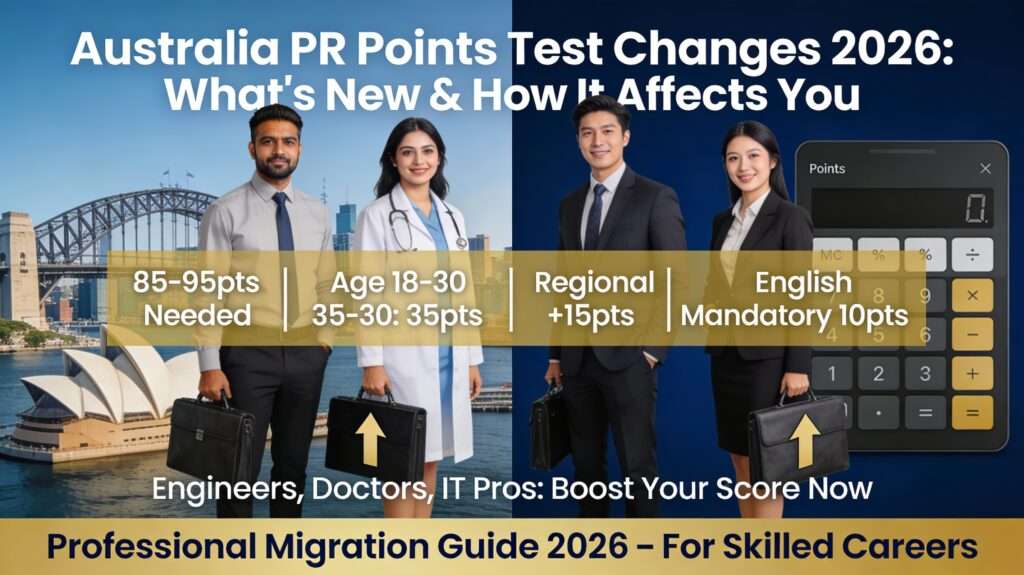
If you are planning to apply for Australian Permanent Residency (PR) in 2026, you are walking into a completely different landscape than applicants from just two years ago.
The Australian Government is undertaking the largest overhaul of its migration system in decades. While the new Skills in Demand Visa (replacing the 482) is already live as of December 2024, the major reforms to the Points Test are the next big wave expected to hit in the 2025-26 program year.
This guide breaks down the confirmed changes versus the proposed 2026 reforms, helping you understand how your PR score might change.
1. The “Skills in Demand” Visa (Already Live)
Note: Many people confuse this with the 2026 changes, but it is already in effect.
As of December 7, 2024, the old Temporary Skill Shortage (TSS 482) visa was replaced by the Skills in Demand (SID) Visa.
- Why it matters for PR: Unlike the old 482 visa, the SID visa gives you a guaranteed pathway to PR. Time spent on this visa counts towards your work experience points.
- The Three Tiers:
- Specialist Skills: For high earners ($135k+). Fast 7-day processing. No occupation list restriction (except trades/labor).
- Core Skills: For standard skilled workers ($73k – $135k). Must be on the new Core Skills Occupation List (CSOL).
- Essential Skills: (Coming mid-2025) For lower-paid critical sectors like Aged Care ($73k and below).
2. 2026 Points Test Overhaul: The Major Shifts
The government’s “Migration Strategy” review has recommended a new points test to focus on future success rather than just “ticking boxes.” Here is how the points table is expected to change in 2026.
A. Age Points: Punishing the “Over 35s”
- Current: You get max points (30) until age 32. Points drop at 33, 40, and 45.
- 2026 Change: The system will aggressively favor younger applicants.
- Winner: Age 25–32 is likely to be the new “Goldilocks zone,” possibly awarding 35 points.
- Loser: Applicants over 35 may see a sharper drop in points. The goal is to recruit migrants who have 30+ years of working life left.
B. English: The New Baseline
- Current: “Competent” English (IELTS 6) is the minimum but gets you 0 points.
- 2026 Change: “Competent” English may no longer be enough to even apply.
- New Norm: You might need “Proficient” (IELTS 7) just to enter the pool (potentially 10 points).
- Superior (IELTS 8): Will remain the standard for competitive candidates, potentially worth 20+ points.
C. Experience: Australian Experience is King
- Current: 1 year of Australian experience = 5 points.
- 2026 Change: The government wants to reward people who are already working in their field in Australia.
- The Shift: Expect higher points for Australian work experience (e.g., 10-15 points) compared to offshore experience.
- Job Offer: A confirmed job offer in a target sector might become a points-earner itself (currently, it usually isn’t for 189/190 visas).
D. Partner Skills: Double or Nothing
- Current: You get points if your partner has “Competent English” (5 pts) or a Skills Assessment (10 pts).
- 2026 Change: To stop “carrying” unskilled partners, the system will likely mandate that partners must be skilled to earn points.
- Impact: Single applicants might face a tougher comparison against couples where both partners are highly skilled (earning 10-15 partner points).
E. Education: Quality over Quantity
- Current: 15 points for a Bachelor’s, 20 for a PhD.
- 2026 Change: The review suggests moving away from “paper qualifications.”
- Impact: A generic Master’s degree (without relevant work experience) might earn fewer points.
- Focus: Degrees in “Skills in Demand” areas (Teaching, Nursing, Engineering) will be prioritized over generic Business degrees.
3. What is Losing Value? (The “Box Ticking” Era Ends)
The review explicitly stated that points should not be awarded for things that don’t predict job success.
- Professional Year (PY): Currently gives 5 easy points. Confirmed Change: The Accounting PY program has ceased new enrollments as of March 5, 2025, and will fully phase out by 2026. Points for PY are disappearing.
- NAATI/CCL: Currently gives 5 points for a community language. This is also seen as a “hack” and may be removed or restricted to actual translators.
- Regional Study: While regional visas (491) remain strong, just “studying” in a regional area without finding a job there may earn fewer points.
4. 2025-26 Migration Cap: The “185,000” Limit
For the 2025-26 financial year, the National Planning Level is capped at 185,000 places.
- Skill Stream: ~132,000 places (70% of the total).
- Family Stream: ~52,000 places.
- The Reality: Competition is higher. With the cap fixed, only high-points candidates (likely 90-100+ points under the current scale) will get invited for 189 visas.
Frequently Asked Questions (FAQ)
Q1: Can I still claim points for Professional Year (PY) in 2026?
Likely No. The Accounting Professional Year program has already stopped accepting new students as of March 2025. It is being phased out because it was seen as a “tick-box” exercise rather than adding genuine skills. If you are currently enrolled, you might still claim points if you finish before the final cut-off, but for new applicants in 2026, rely on other factors.
Q2: Will the age limit for PR change in 2026?
The “hard” age limit remains 45 years for most skilled visas (189, 190, 491). However, the points for age will change. You will likely get 0 points for age once you turn 40 or 45, making it mathematically impossible to get invited unless you have extremely high points in other areas (like superior English or a skilled partner).
Q3: Is the NAATI CCL test being removed in 2026?
Under Review. The migration review recommended removing “Community Language” points unless you are actually working as a translator. While NAATI still offers the test, you should treat these 5 points as “at risk.” Don’t bank your entire strategy on them.
Q4: How many points do I need for a 189 Visa in 2026?
While the minimum is 65, the realistic invitation score is much higher. In 2026, expect to need 90–95 points for competitive occupations (like IT and Accounting) and 80+ points for priority sectors (like Healthcare and Teaching).
Q5: Does the Skills in Demand (SID) Visa require a points test?
No. The SID visa (Subclass 482 replacement) is an employer-sponsored visa. It does not use the points test. You just need a willing employer, the right skills, and to meet the salary threshold. However, to transition from SID to PR (via Subclass 186), you may need to meet age and English requirements, but usually not a points test.
Summary: Winners vs. Losers in 2026
| Profile | Verdict | Why? |
|---|---|---|
| Nurse (Age 26) with Superior English | WINNER 🟢 | Fits the perfect age/skill profile. |
| IT Pro (Age 38) with no Australian Job | LOSER 🔴 | Loses big on age points; lacks local experience. |
| Graduate (Age 24) with Job Offer | WINNER 🟢 | “Skills in Demand” pathway + future PR points. |
| Couple (Both Skilled Engineers) | WINNER 🟢 | Max partner points will be a huge advantage. |
Strategy for 2026 Applicants
- Don’t wait for the change: If you qualify now (under current rules), apply immediately. The new rules will likely be harder for older/less experienced applicants.
- Focus on English: It is the only factor you can control completely. Aim for IELTS 8 / PTE 79+.
- Get a Job: The “Skills in Demand” visa is now the safest bridge to PR. Finding an employer sponsor is more valuable than just collecting points.
Need a Points Assessment?
Unsure if you will pass the new 2026 threshold? At Ausizz Migration Consultants, we can simulate your score under both the current and proposed systems.
Get Your Free Profile Assessment Today!
Contact Ausizz Migration Consultants:
- Website: www.ausizzmigrationconsultants.com
