
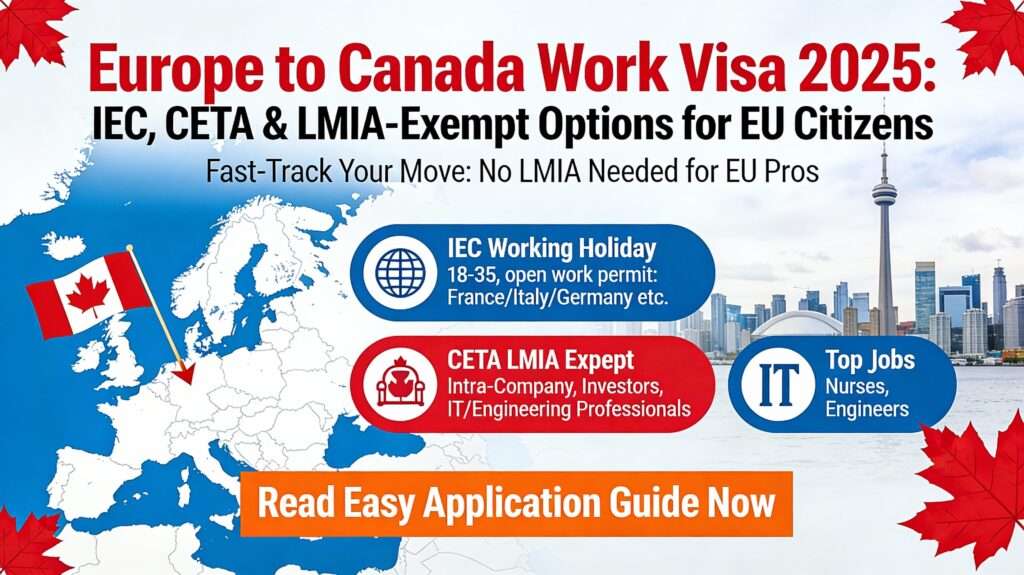
For many Europeans, Canada offers the perfect blend of career growth, stunning nature, and a high standard of living. Whether you are a fresh graduate from Paris, a software engineer from Berlin, or a business consultant from Milan, 2025 presents some of the most accessible pathways to move from Europe to Canada.
Unlike the complex and expensive Labour Market Impact Assessment (LMIA) process required for most global applicants, EU citizens have access to unique “fast-track” options. Thanks to trade agreements like CETA and youth mobility schemes like IEC, your journey to a Canada work permit can be significantly smoother.
This guide details the three most effective routes for Europeans in 2025: International Experience Canada (IEC), CETA Work Permits, and the Francophone Mobility Program.
1. International Experience Canada (IEC): The “Youth” Route
If you are under 35 (or 30 for some countries), this is your golden ticket. The IEC program is designed for youth mobility and offers the easiest work visa application process with no need for a strict job offer (in some categories).
Who Can Apply?
Citizens of most EU countries, including France, Germany, Ireland, Italy, Spain, Portugal, Poland, Greece, and more.
- Age Limit: Typically 18–35 (e.g., France, Ireland, Portugal, Italy). For some countries like Belgium or Netherlands, the limit may be 30 (check specific bilateral agreements for 2025 updates).
The Three IEC Categories:
- Working Holiday:
- The Best Part: You get an Open Work Permit. You can work for any employer in Canada, change jobs, or travel. No job offer is needed to apply.
- Ideal For: Gap years, casual work, and exploring Canada.
- Young Professionals:
- Requirement: You need a signed job offer in your field of study/career (TEER 0, 1, 2, or 3).
- The Permit: Employer-specific (closed) work permit.
- Ideal For: Career advancement.
- International Co-op (Internship):
- Requirement: You must be a registered student in your home country and have an internship offer in Canada.
- Ideal For: Completing university requirements abroad.
2025 Season Update: IEC pools usually open in December or January. For popular countries (like France or Ireland), quotas fill up fast. Create your profile early!
2. CETA Work Permits: The “Professional” Route
The Comprehensive Economic and Trade Agreement (CETA) is a free trade deal between Canada and the EU. It allows certain professionals to get a Canada work permit without an LMIA (Labor Market Impact Assessment), saving employers time and money.
Who is Eligible?
Citizens of all EU member states. You generally need a university degree and professional experience.
CETA Categories:
- Contractual Service Suppliers:
- You work for an EU company that has a contract to provide a service to a Canadian company.
- You enter Canada temporarily to fulfill that contract.
- Example: An IT consultant from a German firm sent to upgrade systems for a Toronto client.
- Independent Professionals:
- You are a self-employed European freelancer with a direct contract with a Canadian client.
- Example: A self-employed architect from Italy designing a project in Montreal.
- Intra-Company Transferees:
- Senior managers or specialists transferring from the European branch to the Canadian branch of the same company.
- Perk: Spouses usually get an open work permit too!
Why CETA? It bypasses the “advertising” requirement. Your Canadian employer doesn’t need to prove they couldn’t find a Canadian for the job.
3. Francophone Mobility Program: The “Language” Advantage
Do you speak French? If yes, the doors to Canada (outside Quebec) are wide open.
- The Goal: Canada wants to increase French-speaking populations in English-majority provinces (like Ontario, BC, Alberta).
- The Benefit: LMIA-Exempt Work Permit.
- Eligibility (2025 Update):
- You must have moderate French proficiency (CLB 5 in speaking/listening).
- You need a job offer in any field (except primary agriculture).
- You must live and work outside Quebec.
- Why use it? Even if you are an EU citizen who doesn’t fit CETA or IEC, this program works as long as you have the French skills and a job offer.
Step-by-Step Application Process (2025)
Step 1: Determine Eligibility
Check if you fit IEC (age/youth), CETA (trade/contract), or Francophone Mobility (language).
Step 2: Secure the Offer (If needed)
- For IEC Working Holiday: No offer needed.
- For others: Your Canadian employer must submit the offer through the Employer Portal and pay a $230 compliance fee. They will give you an “Offer of Employment Number.”
Step 3: Create IRCC Profile
- For IEC: Submit a profile to the “pool” and wait for an Invitation to Apply (ITA).
- For CETA/Francophone: Start your work permit application directly online.
Step 4: Biometrics
Once you submit, you will receive a letter to give fingerprints at a Visa Application Centre (VAC) in Europe (e.g., Paris, Berlin, Rome).
Step 5: Arrival
Upon approval, you get a “Port of Entry” (POE) Letter. Show this to the border officer at a Canadian airport to get your actual work permit printed.
Frequently Asked Questions (FAQ)
Q1: Can I apply for the IEC Working Holiday visa multiple times?
Usually, no. Most countries (like France or Germany) allow you to participate in the IEC Working Holiday category only once. However, you may be eligible to participate again in a different category (like Young Professionals), depending on your country’s specific agreement. Check the bilateral agreement for your citizenship.
Q2: Do I need a job offer for the IEC Working Holiday visa?
No. The Working Holiday category gives you an Open Work Permit, meaning you can enter Canada without a job and find employment after you arrive. For “Young Professionals” and “International Co-op” categories, you do need a job offer.
Q3: Can I bring my family (spouse/children) on an IEC visa?
Not automatically. IEC is an individual permit. Your spouse cannot simply be “added” to your application.
- Spouse: Can apply for their own Open Work Permit only if you find a high-skilled job (TEER 0, 1, 2, or 3) in Canada and can prove you are employed for at least 6 months.
- Children: Can come as visitors, but you may need to apply for their study permits if they are school-age.
Q4: How long does it take to get a work permit from Europe?
- IEC: Once you receive an ITA and submit your documents, processing typically takes 6–8 weeks.
- CETA / Francophone Mobility: Standard processing times for work permits from Europe average 8–15 weeks, but can be faster (2 weeks) if you qualify for the “Global Skills Strategy.”
Q5: Can I apply for a CETA work permit at the airport (Port of Entry)?
Yes, if you are a citizen of a visa-exempt country (like most EU nations). You can bring all your documents (job offer, CETA eligibility proof, contract) to the Canadian border and apply upon arrival. Warning: This is risky if your documents aren’t perfect. We recommend applying online in advance to be safe.
Start Your Canadian Journey
Moving from Europe to Canada is easier than you think, provided you choose the right pathway. Don’t let a simple paperwork error delay your adventure.
Need a Strategy for Your Move?
At Ausizz Migration Consultants, we help EU citizens navigate CETA, IEC, and work permits with precision.
Get Your Free Profile Assessment Today!
Contact Ausizz Migration Consultants:
- Website: www.ausizzmigrationconsultants.com